Pages

Thursday, May 13, 2010

Converting Grass into Meat


I frequently hear the "fact" that livestock production is an inefficient use of land, so I thought I’d have a little fun and dust off some of my old pasture management information. We can debate the numbers, but I don’t think I’m too far off ...

Let's assume the following:

- Dry matter yield from perennial ryegrass & white clover pasture of 10,000 lb per acre
- 75% of the pasture dry matter produced is consumed by the grazing animal
- A conversion rate of 14 lb of pasture dry matter per lb of hanging weight
- An edible yield of 65% of the hanging weight
- A cooked yield of 56% of the raw weight
- A per meal protein requirement of 4 ounces of cooked meat
- 3 meals per day

Under these conditions, a piece of pasture less than 209 x 209 feet could produce enough meat to supply a person's daily protein needs for 260 days (not to mention the lovely fat!). Remember that this land can be completely unsuited to the production of grains, fruits, or vegetables.

If we could bump the pasture yield to 15,000 lbs of DM per acre, we could produce sufficient meat to supply a person's daily protein needs for 390 days!!

Oh, and by the way, perennial pasture produces about as much root dry matter as it does above-ground dry matter, thus fixing more carbon. Even poorly-managed pasture is equal to woodland in terms of "fixing" carbon, while well-managed pasture is many times better.

This from a perennial "crop" that requires minimal fertilizer, pesticides, equipment, or petroleum to produce. But it isn’t “green” ‘cause it’s not vegetarian!

*sigh*

Friday, May 7, 2010

I'm finding it difficult to establish a regular posting routine. Hopefully a consistent effort will produce results, even if I’m not currently meeting my target.

There are certain “givens” in this concept I call Grass Based Health. Here’s a few that I put down as a response to the “Diet-For-a Small-Planet” folks. You know them, right? They’re the ones that say that animal agriculture is an inefficient use of land and that grain-based diets are healthier for us. There are many points that could be made, but let’s start with these:

1. The vast majority of the earth’s land surface isn’t suited to the production of fruits, grain, & vegetables. But a significant portion of it is well suited to the production of high quality protein and fat via ruminant animals and managed grasslands. (That US-type agriculture feeds grain to cattle and sheep doesn’t refute this fact.)

2. Well-managed grass-based agriculture (the production of milk, meat, and fiber from perennial grasslands) is sustainable, and beneficial to the environment (again, the fact that the majority of agricultural practices in the US don’t model this reality doesn’t refute these facts).

3. Unlike fruits, grain, & vegetables, the high-quality protein and fat from animals provides all of the essential amino acids, and fatty acids humans require.

4. Eating the “Diet-For-a Small-Planet” diet is, therefore, the unsustainable, environmentally irresponsible, unhealthful choice that has lead/is leading the world into an epidemic of chronic disease that is awe-inspiring to contemplate – tooth & gum disease, obesity, hypertension, heart disease, diabetes, stroke, cancer, Alzheimers, etc. What is/will be the impact of the resource demand for the treatment of these (and other) diseases that are now known (or strongly suspected) of being the result of high-carbohydrate diets?

One last point: It is possible that there would not have been a slave trade from Africa into the new world if the English and Europeans hadn’t been addicted to sugar …

Dietary choices and agricultural policies have far-reaching implications.

Thursday, April 29, 2010

While I Recover From the Last Three Weeks ...

The last three weeks have been VERY full. Lots of great moments, with the Spring Fling Hammered Dulcimer Gathering capping it all off last weekend. I'm trying to get caught-up, and writing for this blog hasn't been at the top of my list. I'm trying to get into the habit of posting regularly, so here are two informative videos I found on a post Tom Naughton's blog.

I wasn't aware of Dr. Scott Connelly or his Body Rx book and website. From the comments section of Tom's blog I understand that Dr. Connelly has been ill recently and his condition is seen in these videos. No matter, the information is solid and his presentation is good. I've got a slight problem with some of his language, but it's relatively mild.

Dr. Connelly: Talks About Insulin pt. 1
Dr. Connelly: Talks About Insulin pt. 2

Wednesday, April 21, 2010

The Original North American Trail Food


Last weekend I attended the combined meetings of American Society of Bariatric Physicians and Nutrition and Metabolism Society. Among the many great researchers I met was Dr. Stephen Phinney. Over dinner the topic of pemmican came up, and we shared our recipes. During his presentation he discussed the importance of pemmican in the diets of the people who inhabited the Great Plains of North America prior to, and for some time after, the arrival of European settlers.

Pemmican is produced by pounding or grinding dried lean meat and combining it with rendered fat. It is equal parts, by weight, of dried meat and fat. Pemmican kept indefinitely without refrigeration, had a greater nutrient density than any other food, and as such, was the ideal “trail-food”. It sustained the Plains people in extraordinary health for centuries, and fueled the European exploration of North America and beyond. And then the modern nutritionists decided it needed to be “improved.”

Convinced that this meat and fat mixture couldn’t be “healthy” without vegetable matter, they started formulating various mixtures with nuts, dried berries, dried fruit, and grains in varying proportions based upon their own unsupported theories. Whatever your belief about the essentiality of carbohydrates in the human diet (they aren’t!), one fact is clear: the addition of carbohydrate to traditional pemmican reduces its nutrient density.

Remember the story of the British Antarctic Expedition of 1910, led by Robert Falcon Scott? Barry Groves explains in his book Trick and Treat that Scott was talked into supplying the party with this “improved” pemmican.

Anyone who’s been backpacking knows that the weight of your supplies is a limiting factor. Outfitting an expedition is a situation where nutrient density (amount of nutrients per pound of foodstuff) is critical. Returning from successfully reaching the South Pole (although they were beaten to the goal by a Norwegian team lead by Roald Amundsen), the three surviving members of Scott’s party died shortly after March 29, 1912 - 11 miles short of a major supply depot. Groves suggests that Scott and his party are among the first victims of the “modern” nutritionists.

Nancy read The Fat of the Land, by the Canadian Arctic explorer and ethnologist Vilhjalmur Stefansson.
Stefansson lived among the Inuit and other northern peoples for extended periods. He reported that these people ate a diet consisting of animal fat and protein and were remarkably healthy. Again, the nutritionists disagreed. It couldn’t be true because they knew humans needed vegetable matter to provide “essential” nutrients. Stefansson ultimately proved his point by submitting to a year-long study where he ate an all-meat diet. But perhaps that’s a story for another post.

Armed with Stefansson’s description of pemmican as a 1:1 dried meat to fat mixture by weight, we began our experiment:

Starting with our oven-dried beef. Remove as much fat as possible, and slice it thin. Place it on racks in the oven at 150 F. Every half hour or so, turn the pieces to promote even drying. There are other methods. Dr. Phinney uses a microwave set on 10% power. I’m afraid I didn’t get all the details during our dinner conversation. I’ll try to get the full information. If I do, I’ll post it here.
Rather than pounding the jerky to produce shreds, I used the food processor to chop it up.

I’ll try to leave it a little coarser in the future.

Transfer the meat to a bowl and add an equivalent amount of melted fat.

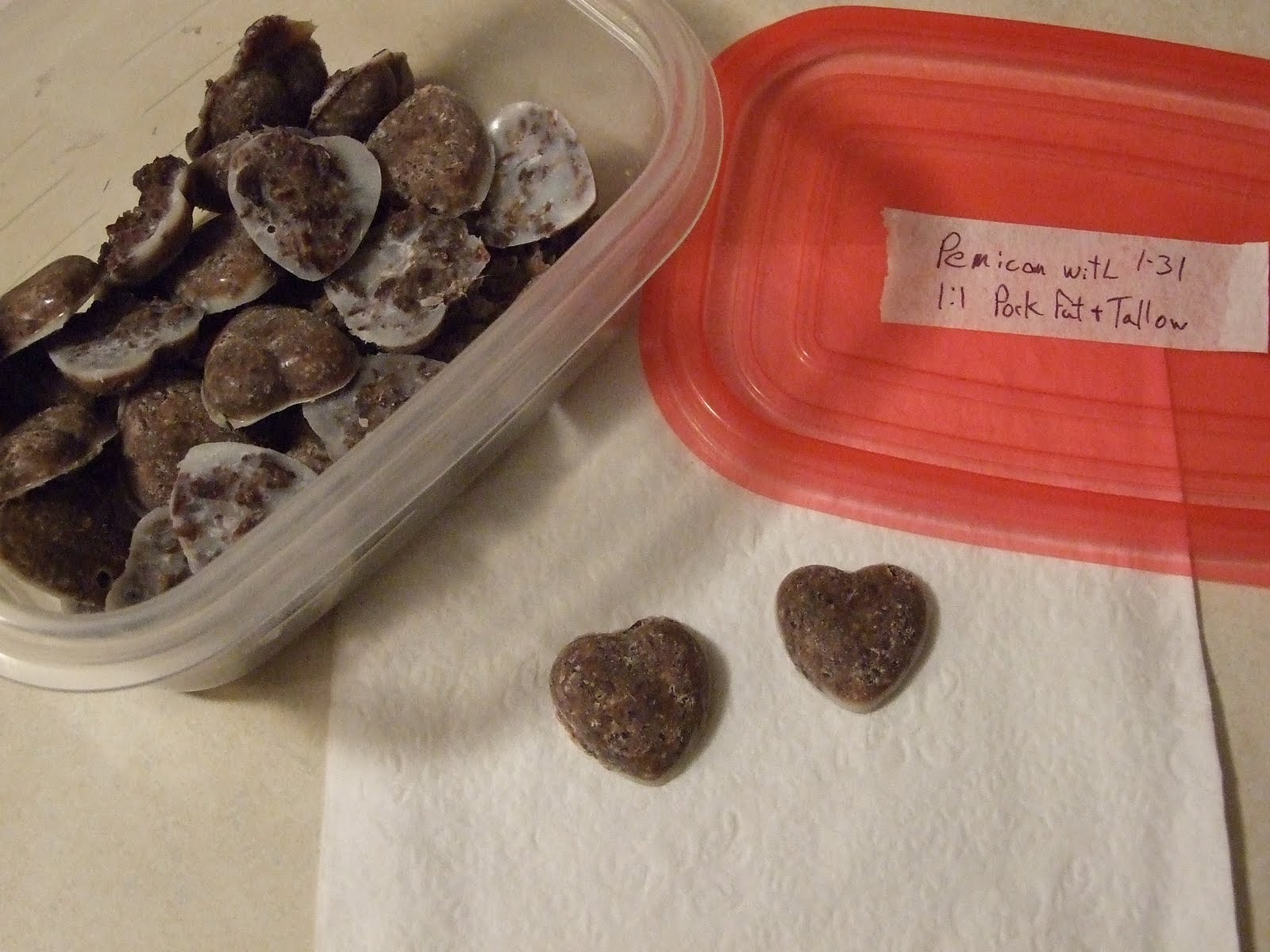
We’ve used home-rendered beef tallow, but the flavor is a little strong for us. Instead, we use a 50-50 mix of tallow and lard which we render from our locally produced, grass-fed beef and pastured pork. Because of the lower saturated fat content of the lard, this pemmican is softer than pemmican made with tallow would be. We store them in the refrigerator, so that’s not an issue.
We use some inexpensive candy molds to make bite-sized pemmican pieces.

After cooling in the refrigerator, they pop out of the mold fairly cleanly.

Two of these are a lot to eat, approximately 5 grams each, 38 Kcal, 1.2 g Protein & 2.5 g fat. Compare that with those "100 Calorie pack" snacks items ...
Dr. Phinney appreciated the irony of the shapes. Heart-healthy! We’re not planning to apply for Heart Check logo approval …

Sunday, March 14, 2010

First post! Taking the plunge ...

This is a "Blurb" I've used for a talk I've started giving to agricultural audiences. It seemed like a good thing to use for a "test-drive".

Grass Based Health: Turning the Food Pyramid Upside Down

Conventional wisdom, when it comes to human nutrition, tells us that we should be eating a low-fat diet, with restricted consumption of red meat. This advice became the official recommendation of the United States government in the late 1970’s. Peter Ballerstedt will introduce evidence that the fat-is-bad hypothesis was wrong, and the impact the growing awareness of this can have on animal agriculture in Oregon.

Peter has an extensive background in forage production, utilization, and forage-based livestock production systems. He was the forage extension specialist at Oregon State University from 1986 until 1992. His recent personal experiences led him to study human diet and health. What he’s learned doesn’t agree with advice we’ve been given for the past 30 years or more. This new understanding, combined with his forage background, has given him an interest in local, sustainable food production systems. His knowledge, enthusiasm, and speaking style will provide an entertaining and informative presentation.

And here's a .wmv file that I made by combining an audio recording of the talk I gave to the Central Oregon Hay Growers Association with some of the slides I used (I couldn't capture all of the animations from the PowerPoint slide deck ...)